

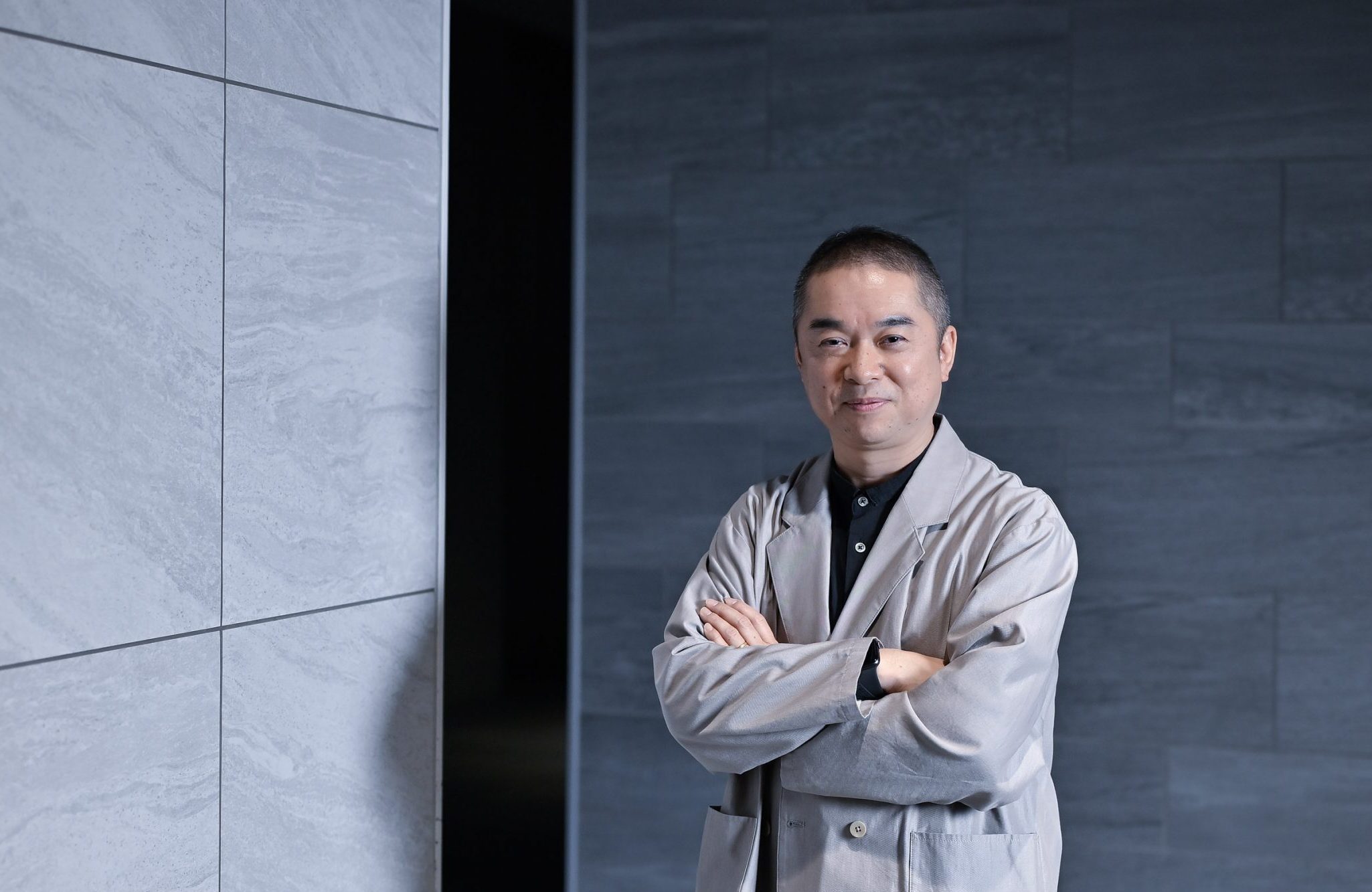
Takuya Yokoyama
Playwrights’ Guide to Their Own Works Vol. 4 ー Takuya Yokoyama on Stitchers
Photo: Akihito Abe
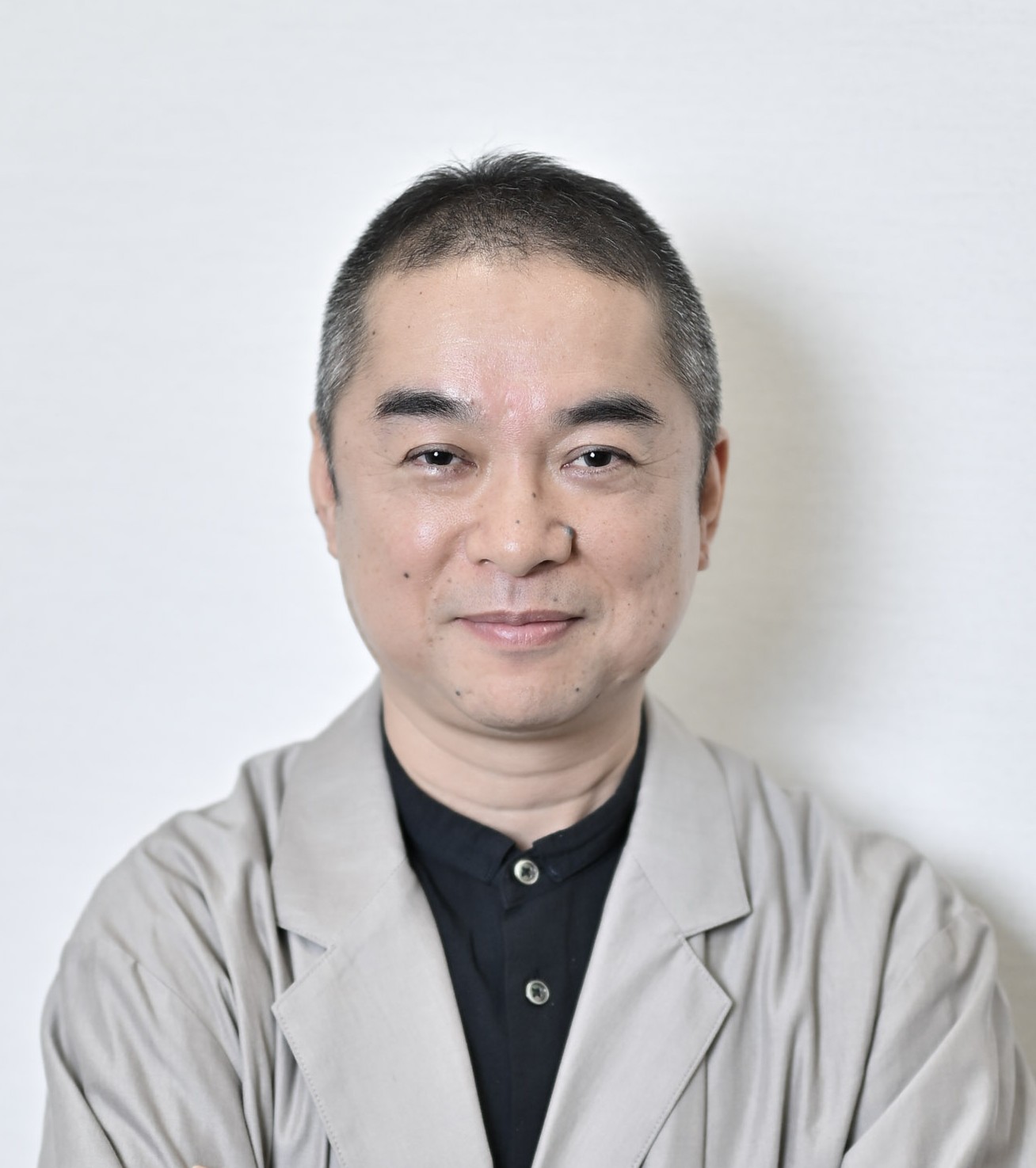
Photo: Akihito Abe
Takuya Yokoyama
Born in 1977 in Osaka Prefecture, Takuya Yokoyama is a playwright and director, and the head of theater unit iaku. While studying at Osaka University of Arts, he founded the theater company Urikomitai Beam with his classmates in 1996. Garnering attention as a promising young talent, he served as playwright and director for the company until his departure in 2011. In March 2012, he founded the theater unit iaku, creating works both in Osaka and Tokyo. He has presented dialogue-driven plays characterized by meticulously crafted conversations that build upon each layer like an ascending spiral staircase, bringing the audience into the characters’ struggles before they even notice. Grounded in sharp observations and thorough research, he strives to write plays that capture people and subjects through a multifaceted lens. His works are highly regarded for their entertaining and humorous dialogue while addressing social issues of everyday life. As an advocate for “durable theater” he actively restages his works over time. iaku’s first work and three-hander Hito no Ki mo Shiranaide (premiered in 2012 and awarded the Grand Prize at the 1st Sendai Short Play Prize) and Edaniku (premiered in 2009 and awarded the 15th Japan Playwrights Association’s New Playwright’s Award) have both been widely produced by other companies as well. In 2024, Momonba’s Tie Trap received the 27th Tsuruya Namboku Text Award. In 2025, Yokoyama was awarded the 59th Kinokuniya Theatre Award (Individual category) for writing and directing Nagarenna and for writing Watashitachi wa Monogatari. (Updated in April 2026)


In the fourth series of this installment in which we ask playwrights to describe their plays, we feature Stitchers, one of the renowned works of Takuya Yokoyama—a master of intimate, finely crafted dialogue. In addition to restagings, this simple yet universal work allows for various forms of staging without the supervision of the writer. With its online publication through EPAD and Stage Beyond Borders (SBB), the play is expected to gain international demand as well. Akiko Kaneda—an editor from Yokoyama’s hometown who has known him since the beginning of his theater career—asks him about his playwriting techniques that elicit widespread empathy while still remaining committed to the specificity of Osaka.
Interview and Text by Akiko Kaneda
English Translation: Hibiki Mizuno, Keith Spencer (Art Translators Collective)
iaku, Stitchers (Premiere version)
-
iaku, Stitchers
Written and directed by Takuya Yokoyama
Cast: Nobuhisa Ogata, Fuku Kondo, Buntaro Ichihara, Eriko Ito, Sachiko Sato, Iyuri Hashizume
Tokyo: June 2–6, 2017 at Shinjuku Opthamologist Gallery, basement space, Osaka: June 9–11, 2017 at Independent Theatre 1st. During the 2018 revival tour, this play was performed in Tokyo, Chiryu, Sendai, Hakata, Sapporo, and Sagamihara
Synopsis
When the eldest son, Hajime, and his younger brother, Tsunagu, of the Chikuno family visit their mother in the hospital, she introduces them to an elderly gentleman named Mr. Kanazawa, who appears to have a close relationship with her. Having been diagnosed with pancreatic cancer, their mother has decided to spend her final days in peace upon consulting with Mr. Kanazawa. Meanwhile, in the Takuma family, we meet a young couple who married on the condition that they would not have children. However, the wife Satoko suspects that she may be pregnant, and finds herself unable to bring it up with her husband, Osuke. Considering their work and daily life, having a child is not an option; something she cannot and does not want to choose. However, time mercilessly continues to pass. A life nearing its end and a life at its very beginnings emerge through the conversations among the two families. Through carefully constructed dialogue, the play portrays the conflicting feelings lying beneath seemingly ordinary lives.
List of Characters
Hajime Chikuno: Eldest son of the Chikuno family. Single and lives with his mother. 41 years old.
Tsunagu Chikuno: Hajime’s younger brother. Married and 38 years old.
Satoko Takuma: Osuke’s wife. 38 years old.
Osuke Takuma: Satoko’s husband. 38 years old.
Yui: A stitcher.
Ito: A stitcher.
-
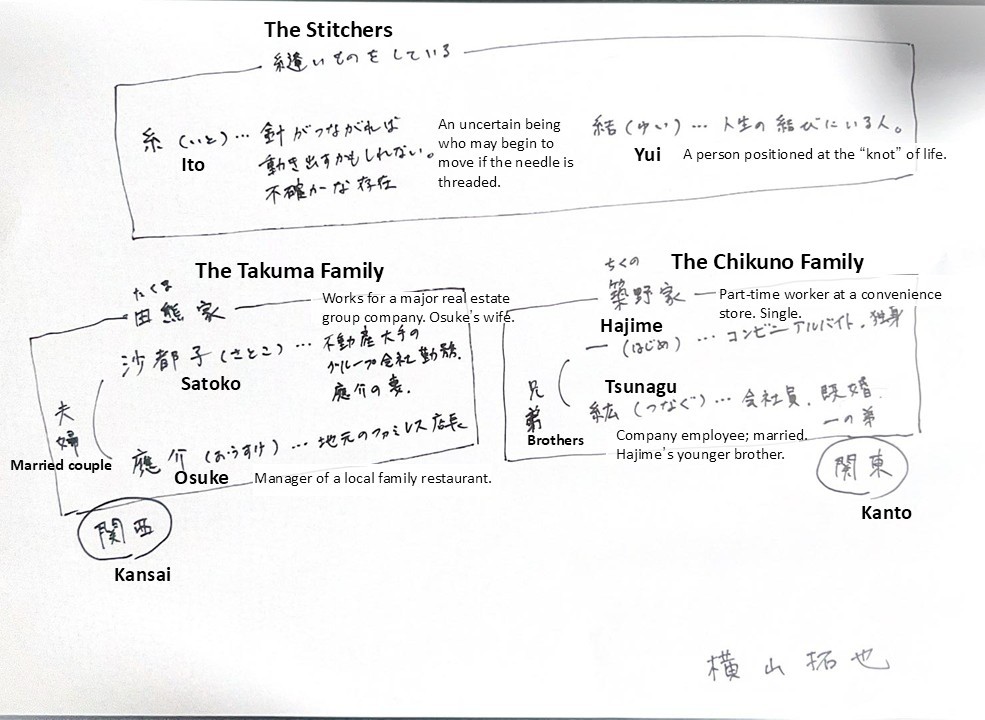
Character relationship chart for Stitchers created by Takuya Yokoyama
Takuya Yokoyama is a playwright based in Osaka who has produced numerous works since his university years. Even after moving his theater unit iaku to Tokyo in 2015, he has intentionally continued working with the Kansai dialect and themes regarding Osaka, writing works with intricate layers of everyday dialogue. The work we delve into here, Stitchers (premiered in 2017), takes on a more fantastical structure, a rare direction for Yokoyama who is known for his realistic straight plays. We explore his feelings behind the work, which draws a parallel between the word in the original Japanese title, unshin—meaning the hand of a clock or a way of stitching—and the passage of life.
Until Stitchers, iaku’s works would depict the ways that people would grapple with one particular issue through interpersonal dialogue during a set period of time; so 90 minutes would pass in the world of the play if it were a 90-minute performance. For example, in the piece Shaso kara: Sekai no,1 people who are waiting a long time for a train that doesn’t come end up encountering unexpected things. Some audience members pointed out that the justification for staying somewhere for so long when the characters aren’t necessarily trapped felt weak. I thought that they might stay because the discussion becomes heated, but it’s true that if you need to go somewhere and are short of time, it’s not realistic that you would stay in the same place for 90 minutes.
I knew that the fantastic presence of Ito (thread), which represents life to be born, and Yui (knot), which represents life at its end, would affect the discussions that the two pairs were having. Although the characters do not directly talk to the families, they influence not just me as the writer but especially the audience members. This kind of triangular dynamic, and depicting the sensation of two families intertwining together was a theatrical challenge for me, and I remember trying hard to refine the dialogue when working on the first draft. When I was done, I really felt that I had been able to write something substantial for the first time in a while, and as a result, this became a turning point in my career.
-
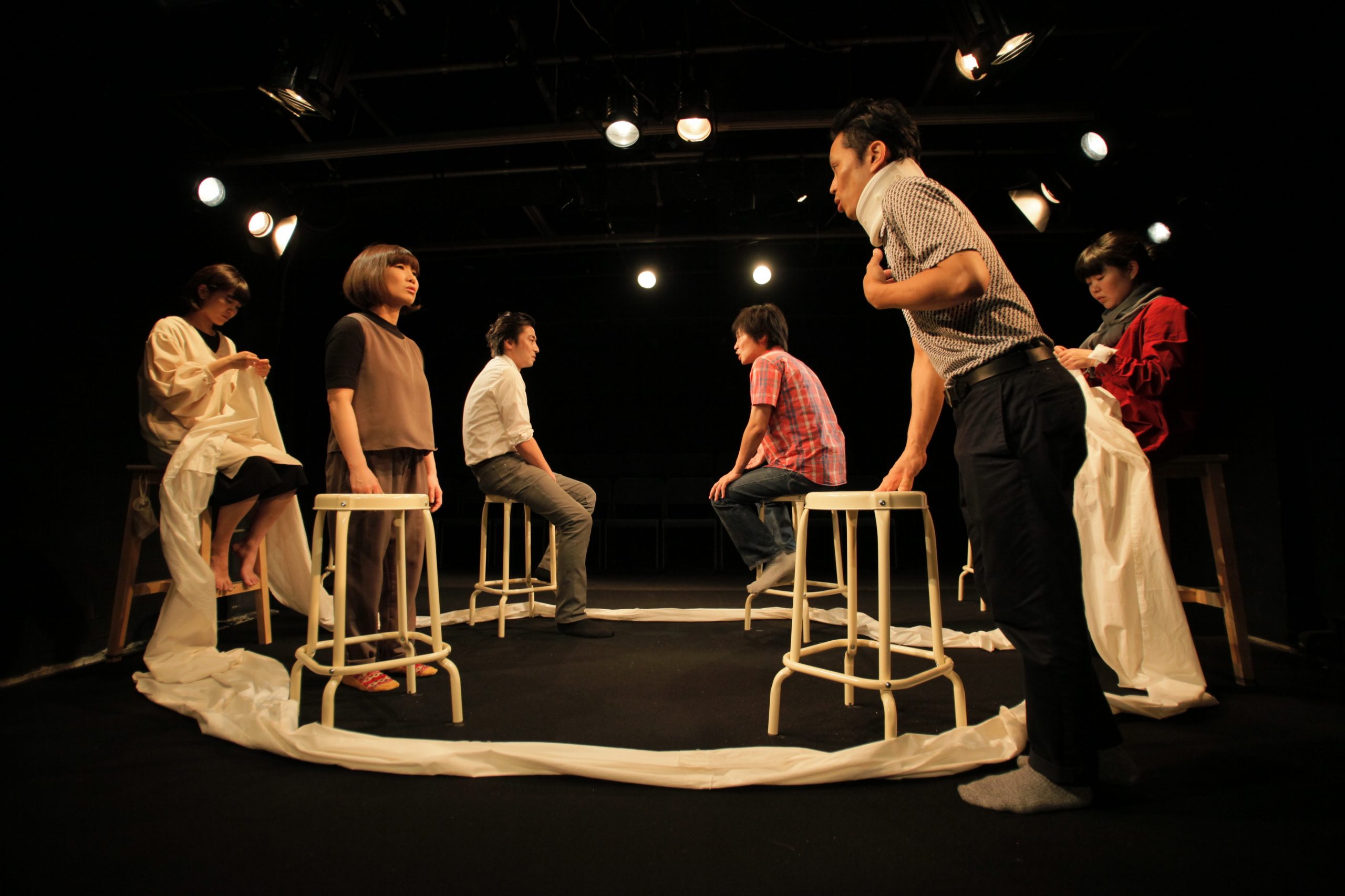
iaku, Stitchers, 2017 Photo: Takashi Horikawa
In terms of the male characters, I do think I drew a lot from my own sensibilities. I myself have a wife and a child, and I dramatized a lot of the elements seen in the stories of the brothers Hajime and Tsunagu, drawing from my own experiences with my mother and my younger brother and seeing them from different distances. For example, the part about not saying “good morning” to the mother comes from my own experience. It’s not that we don’t get along, but I perhaps feel a bit shy about saying something like that when we both know that we are awake [laughs]. I’m sure that many people can also empathize with feeling shy about crying in front of their mother or sharing their love life with them, so I wanted to verbalize and depict these kinds of sensibilities, the kind of distance we feel with family members.
-
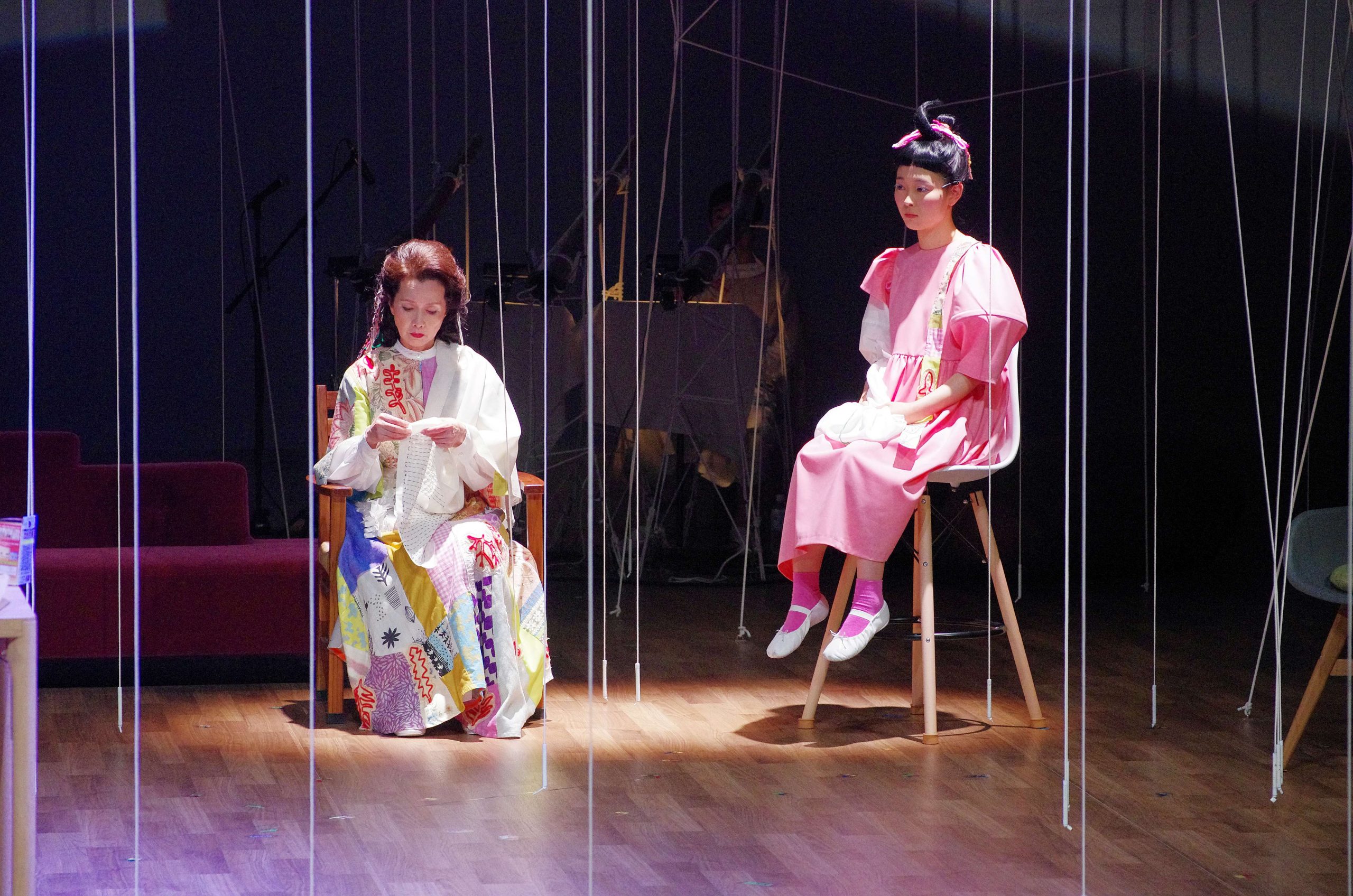
PARCO PRODUCE, Stitchers, 2022 Photo: Yoshinori Mido Photo courtesy of PARCO Co., Ltd.
Yumi Takigawa(Left), Hana Kawamura(right)
Ikken is a very reliable collaborator who can point out the things that I unconsciously write. He reviews the script as a piece of writing and really enjoys each of the decisions I make with the words in the dialogue. He picks up the entertaining factors within the script and clearly understands the work’s aim. He is somebody who can help us discover the path to bring the text to life. Ikken is also the leader and director of a comedy troupe called Square (currently on hiatus), so he’s always writing scripts for humor. I think one of my strengths is how I interweave humor into scenes that are depicting people confronting some kind of issue, so I hope we can bring out Ikken’s genuine attitude toward funny things and his knack for philosophical elements like literature and written text to discover the fascinating things in my play, which is written in a kind of casual, nonchalant tone.
One major point he made had to do with the fantastical presence of Ito (representing the life to be born). Ikken pointed out that even though the husband and wife in the Takuma household are discussing whether or not to have the baby, that perhaps the wife (Satoko) was being pressured to have the baby. This is something that’s difficult to catch in the script, but when it’s brought to life on stage, the very presence of Ito as a character could make it seem like giving birth is the goal. Ikken wasn’t convinced this was really what the play was trying to achieve, and when I heard that, I realized he was absolutely right. I didn’t write this play to make a judgement on anything, so it wasn’t my intention to orient the story around the assumption that Ito would be born. I want to give the Takuma couple a sense of ambiguity, or a freedom of choice, a wide range of options. Ito is an unusual role among my plays, and I’ve struggled with how to depict this character ever since I directed the premiere. I’ve had countless conversations and revisions, and discussions with actors during rehearsals to try and resolve things further, but creating dialogue for a character with no personal history, a character that doesn’t exist, is hard given that my writing style is grounded in realism.
-
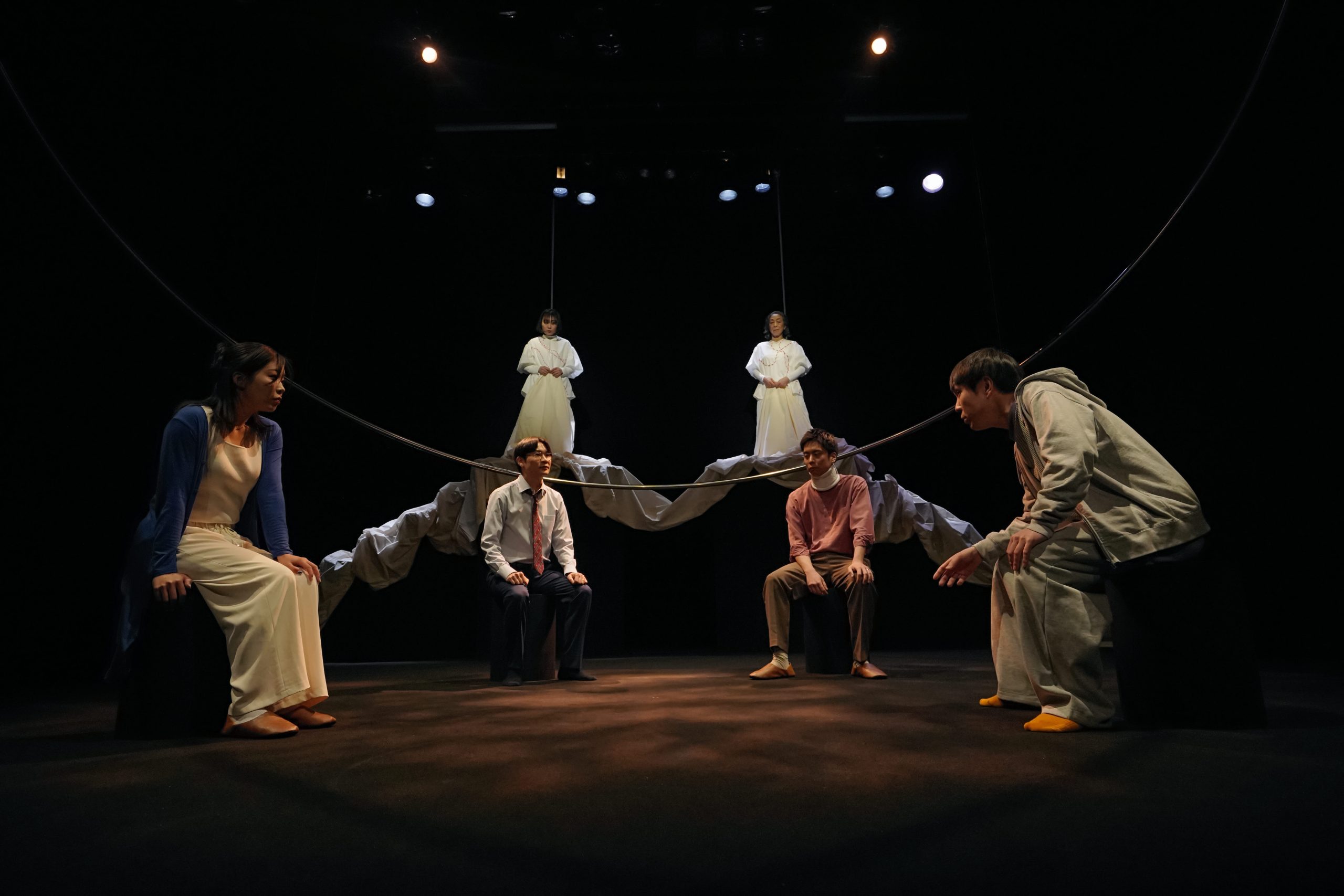
iaku, Stitchers, 2026 Photo: Takashi Horikawa
Another reason is because I saw Tokyo-based theater companies performing in Osaka at the time, including Guringu (2005, Kaizoku, Osaka City Geijutsusozokan) and Modern Swimmers (2008, Night Glow Hotel -Suite Room Version-, Seika Little Theater) and I was really impressed by how skilled the actors were. When I thought about why that might be, I realized that the play hadn’t been written in standard Japanese, but rather in the Tokyo dialect that the actors used every day. I was familiar with the “contemporary colloquial theater theory”4 advocated by Oriza Hirata of Seinendan, but their dialogue felt even more realistic. So I thought, if I write my plays in the colloquial Kansai dialect that we use every day, people outside of Kansai will be impressed by the actors’ skills when they see the play. The plan worked brilliantly. Combining this with Ikken’s direction, who continues to work in Osaka, the actors were able to embody my intentions. I think this approach has also contributed to the work of Susumu Ogata, who has appeared numerous times in iaku performances.
I don’t really have many conditions I specify for performing the work, but I do ask that they let me see any revisions in advance. For example, if a character’s gender is changed, I carefully consider whether the story itself still works. But I’m fine if people want to change the Kansai dialect to another regional dialect, and I encourage performers to do so.
I’m not interested in preserving snobby work. I think we should embrace directing approaches that resonate with audiences in the regions where they’re performed. This might sound presumptuous, but works by Shakespeare and Chekhov are being performed now in ways that would have been unimaginable at the time. My thinking now is that it’s a delight for a playwright if their work takes on a life of its own in that way. I hope that Stitchers will also have the opportunity to be performed overseas. I wrote the conversations between the brothers and the husband and wife with a Japanese sensibility, but what they’re talking about is universal, so my guess is that there are similar feelings that exist in any country or region of the world.
-
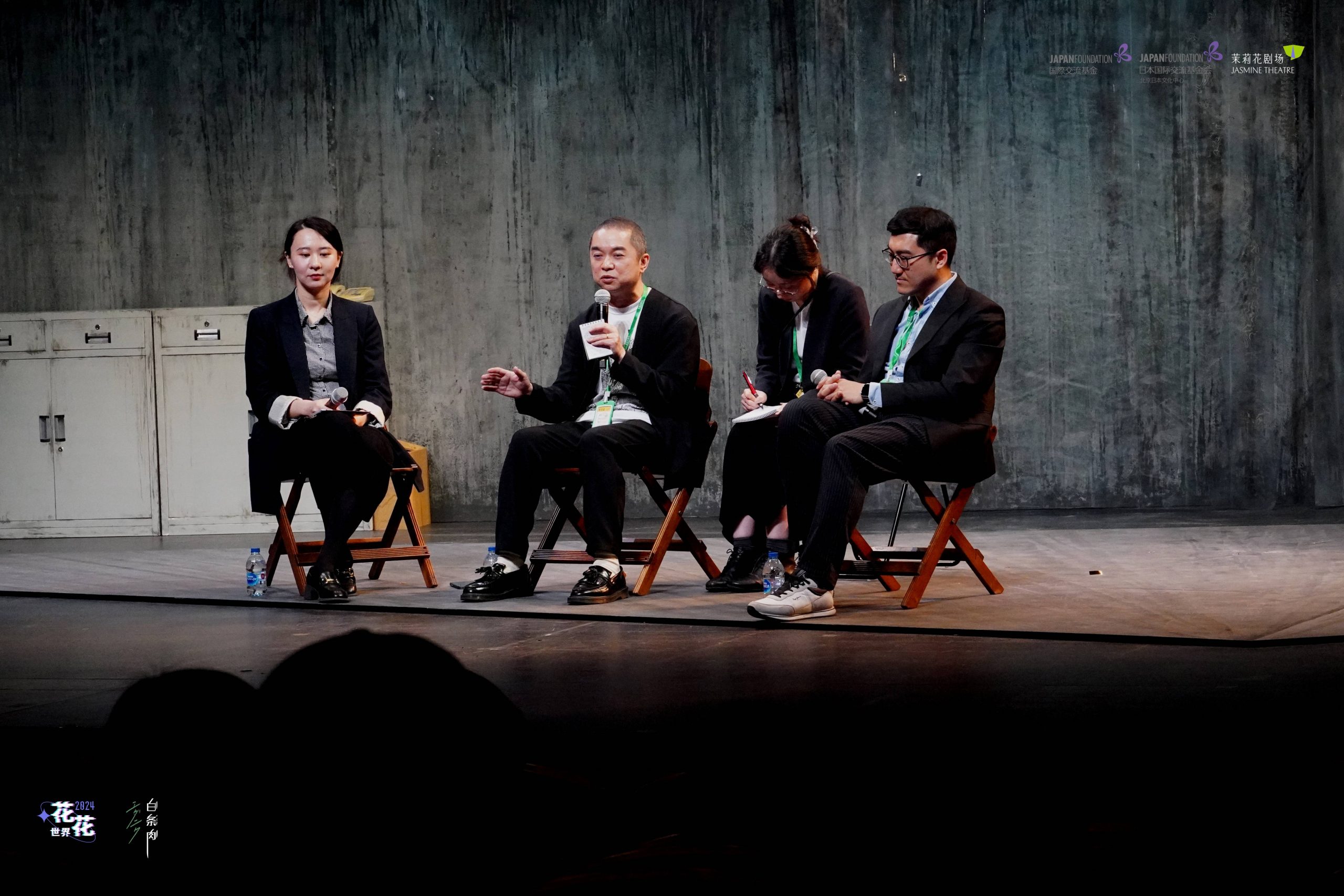
Yokoyama (second from left) in conversation with director Minyuan Li (far right) onstage at the Shanghai Theatre Academy production of the Chinese-language version of Edaniku (2024).
What I want to write about hasn’t changed since I first started writing scripts: the complexity of being human, the very essence of being human. How do people in contemporary society behave when confronted with a problem, how can I expose their inability to behave properly? While depicting these unavoidable aspects of our humanity, I also want to explore whether we can live our lives not by blaming each other for these things, but rather by forgiving each other.
Performance Information
-
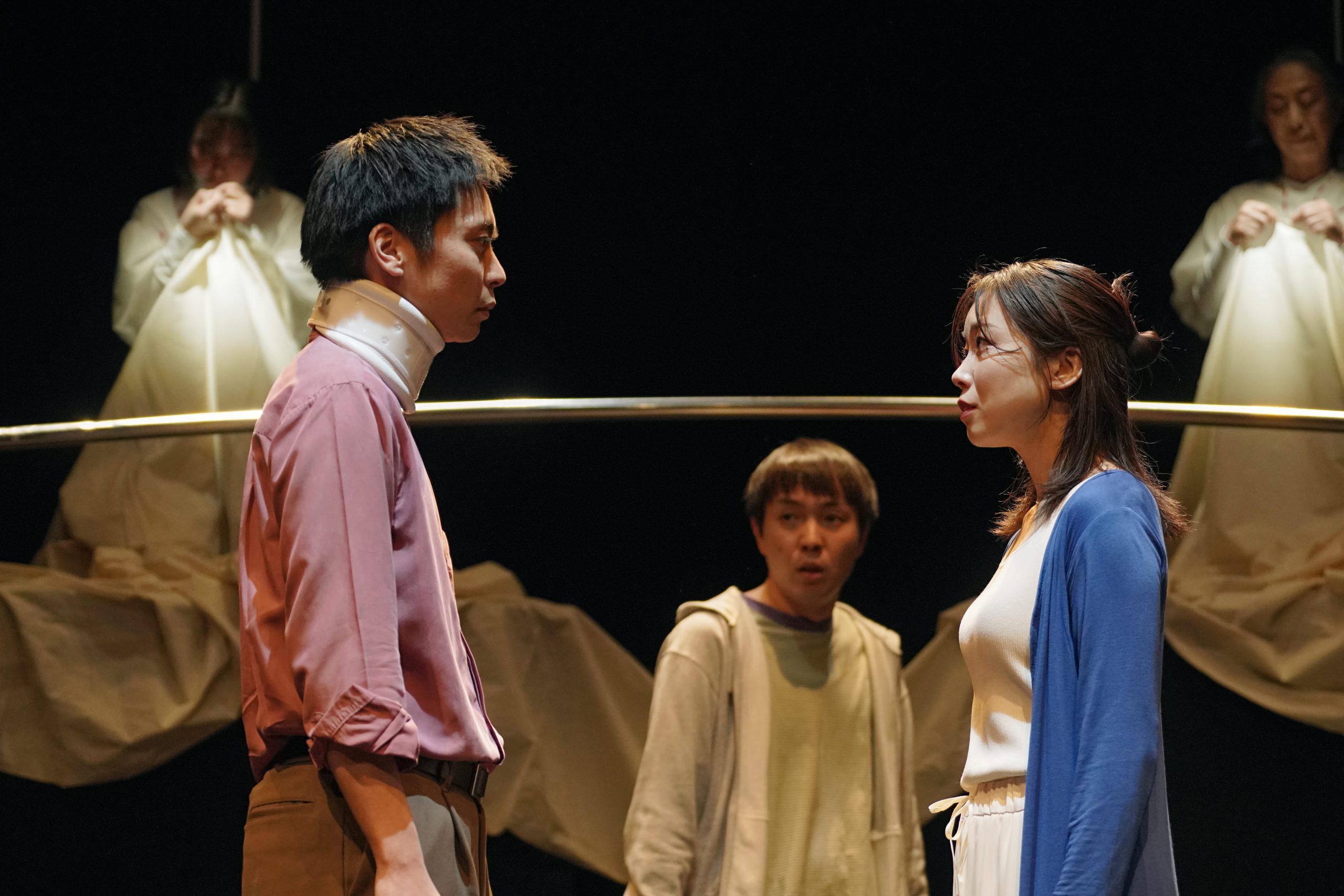
iaku, Stitchers Photo: Takashi Horikawa
Written by Takuya Yokoyama
Directed by Ikken Ueda
Cast: Yasuko Sasaki, Yoshihiro Nakayama, Yusuke Hanato, Mishiyoshi Suzuka, Cyon Rifa, and Hideyo Hayashi
Osaka: March 27–30 at Independent Theatre
Tokyo: April April 9–19 at Mitaka City Arts Center, Hoshi no Hall
Niigata: April 25 at Ryutopia Theatre
-
Shaso kara, Sekai no
Premiered in 2014 as an experimental “off-theater” performance organized by the Piccolo Theater Troupe, the first prefectural theater company in Japan established in 1994 by the Hyogo Prefectural Amagasaki Youth Creative Theater Piccolo Theater. In 2016, this play was performed as an iaku production and directed by Ikken Ueda.
-
Shinjuku Opthamologist Gallery
A contemporary art gallery opened in Shinjuku, Tokyo in December 2004. The first floor is a gallery space for contemporary art, photography, and video work, while the basement floor has a small space with 20 to 40 seats for theatrical performances and other events.
-
Parco Theater
A theater located in the Shibuya Parco shopping complex in Shibuya, Tokyo. Originally called Seibu Theater, it opened in 1973, closed in the summer of 2016, and reopened in March 2020 with an expanded seating capacity from 458 to 636 seats. The theater has been a leading venue in presenting numerous entertainment productions.
-
Contemporary Colloquial Theater Theory
In the 1990s, playwright and director Oriza Hirata advocated incorporating daily conversational language (colloquialisms) into plays, which had a significant impact on contemporary Japanese theater.
-
Playtext Digital Archives
Since 2021, the Japan Playwrights Association has organized, produced, and operated this website to help more people read and enjoy plays—and to encourage their performance in ways that respect the work and its creators. As of March 2026, Yokoyama’s plays listed on the site include Hito no Ki mo Shiranai de and Edaniku, as well as Kamen Fufu no Kagami (first performed in 2011) and Momonba’s Tie Trap (first performed in 2023). https://playtextdigitalarchive.com/public/
-
Ainiiku no, Ame dakedo
Premiered in 2018 at the Hoshi Theater of the Mitaka City Arts and Culture Center. Since its 2022 reading performance at the National Theater Company’s Baek Sung-hee Changmin-ho Theater in Cheongpa-ro, Yongsan-gu, Seoul (translated by Hyeri Lee and directed by Young Lee), this play has been performed in various productions.
-
Edaniku
A representative work by Takuya Yokoyama first performed at Manatsu no Kai in 2009. A Chinese version (translated by Zheng Shifeng) was published as part of the Japan Foundation’s Translation and Publication of Theatrical Plays, and was performed by the Shanghai Theatre Academy in China in 2024, directed by Minyuan Li. In 2025, a Spanish version (translated by Marta E. Gallego) was performed by the Madrid-based theatre company KATSUKO. The directors were Samuel Viyuela Gonzalez and Alba Enriquez.
https://performingarts.jpf.go.jp/en/article/6383/
-
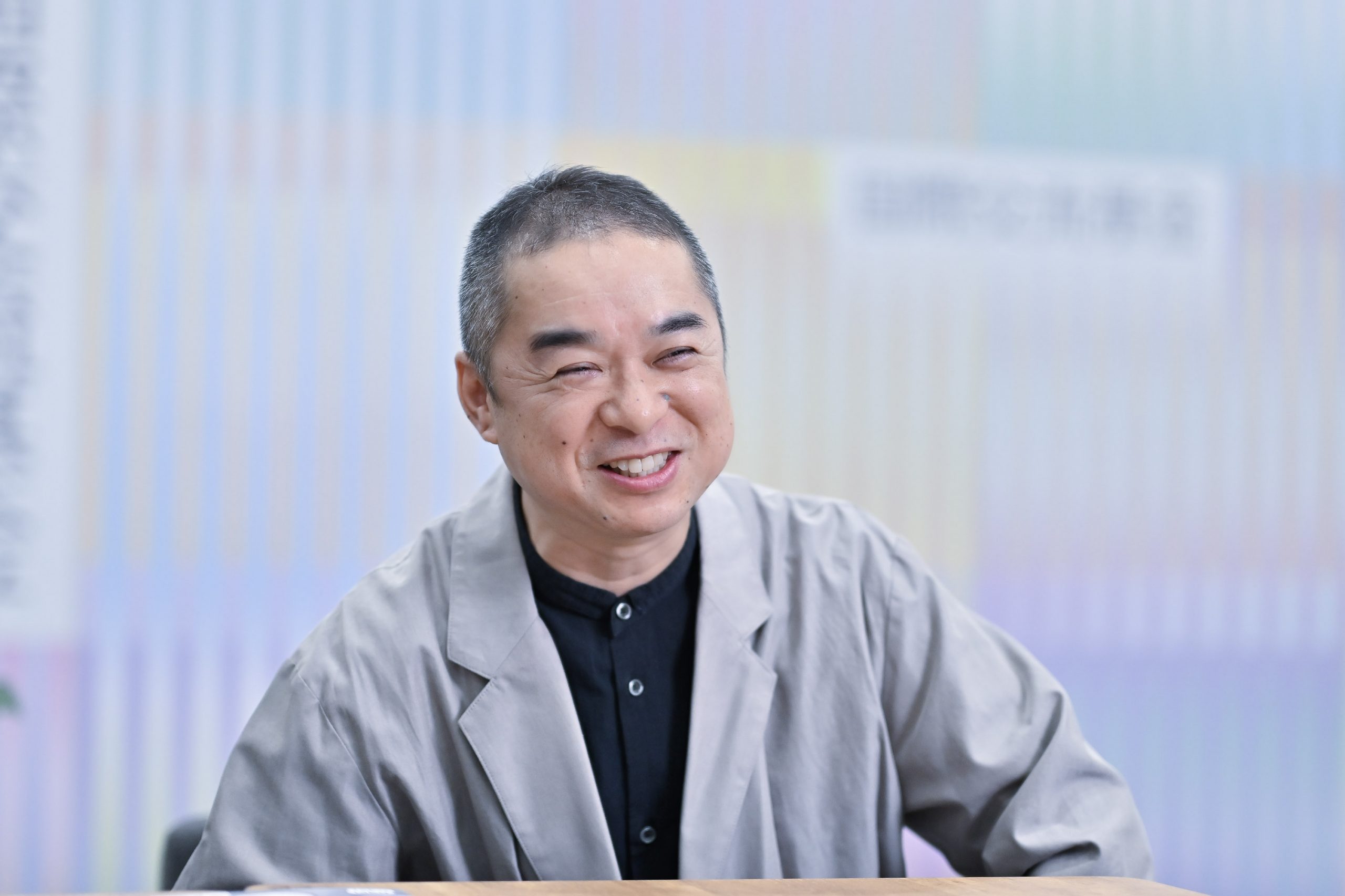
Photo: Akihito Abe
With the cooperation of iaku